Selank vs. Semax: The Two Heptapeptides in Neuroscience Research
Technical comparison between Selank (a tuftsin analog) and Semax (an ACTH 4–7 fragment analog): origin, structure, studied mechanisms, published data, stability, and reconstitution. A laboratory guide.

Selank and Semax almost always come up together. They share the same number of amino acids, the same Pro-Gly-Pro ending, the same origin in the Russian school of regulatory peptides, and, often, the same shelf in research peptide catalogs. The similarities end there. One derives from a pituitary hormone fragment, the other from an immune-system peptide, and the pathways studied for each are different.
This article puts the two heptapeptides side by side: where they come from, what sets them apart structurally, what has been published on each, and how to choose between them in a neuroscience protocol.
1. What Is Semax (an ACTH 4–7 Analog)
Semax is a synthetic heptapeptide with the sequence Met-Glu-His-Phe-Pro-Gly-Pro. The first four amino acids (Met-Glu-His-Phe) correspond to the 4–7 fragment of adrenocorticotropic hormone (ACTH). The ACTH 4–10 fragment had been known since the 1970s for effects on learning and attention in animal models, independent of hormonal activity on the adrenal cortex, but it was degraded within minutes.
Ashmarin's group at the Institute of Molecular Genetics in Moscow designed Semax in the 1990s (Ashmarin et al., 1995), keeping the active 4–7 core and adding the Pro-Gly-Pro tripeptide at the C-terminus. The result: a molecule with no hormonal activity on the adrenal gland, but with enough enzymatic stability for in vivo studies.
Main published research directions:
- Neurotrophins. Dolotov et al. (Brain Research, 2006) reported that Semax increases the expression of BDNF (brain-derived neurotrophic factor) and its receptor TrkB in the rat hippocampus. This is the most cited study on the molecule.
- Gene expression in ischemia. Medvedeva et al. (BMC Genomics, 2014) performed a genome-wide transcriptional analysis on a rat model of focal cerebral ischemia, identifying changes in immune- and vascular-system genes.
- Melanocortin system. Through its ACTH origin, Semax is studied as a partial ligand of melanocortin receptors in the central nervous system.
2. What Is Selank (a Tuftsin Analog)
Selank is a synthetic heptapeptide with the sequence Thr-Lys-Pro-Arg-Pro-Gly-Pro. The first four amino acids (Thr-Lys-Pro-Arg) make up tuftsin, an endogenous tetrapeptide discovered in the 1970s as a fragment of the immunoglobulin G heavy chain, involved in stimulating phagocytosis. As with Semax, the Pro-Gly-Pro extension was added for stability.
Selank was developed by the same institute, in collaboration with the Institute of Pharmacology of the Russian Academy of Medical Sciences, in the early 2000s. The first studies (Kozlovskaya et al., 2003) characterized the molecule in animal models of adaptive behavior under stress conditions.
Main published research directions:
- GABAergic system. Filatova et al. (Frontiers in Pharmacology, 2017) studied, in the IMR-32 cell line, the effect of Selank on the expression of genes involved in GABAergic neurotransmission, compared with GABA and olanzapine. This study is the reference point for the hypothesis that Selank modulates the GABA system.
- Interferon and immunity. Through its tuftsin origin, Selank is studied at the interface of the nervous and immune systems, including effects on interleukin and interferon expression (reviewed in Vyunova et al., 2018).
- Enkephalins. Several papers report that Selank inhibits the enzymes that degrade enkephalins, prolonging the activity of endogenous opioid peptides in experimental models.
3. Structure: Same Length, Different Origins
It is useful to line up the sequences:
- Semax: Met-Glu-His-Phe-Pro-Gly-Pro
- Selank: Thr-Lys-Pro-Arg-Pro-Gly-Pro
The active core (the first four amino acids) has nothing in common. Semax has a hydrophobic core, with methionine and phenylalanine, derived from a hormone. Selank has a basic core, with lysine and arginine, derived from an antibody fragment. The shared Pro-Gly-Pro extension is an engineering solution, not a biological link.
The compositional difference has practical consequences: the methionine in Semax is sensitive to oxidation, which makes the molecule more demanding to store than Selank. Both, however, are stable as lyophilized powder at 2–8°C.
4. Table: Selank vs. Semax, Full Comparison
| Feature | Selank | Semax |
|---|---|---|
| Sequence | Thr-Lys-Pro-Arg-Pro-Gly-Pro | Met-Glu-His-Phe-Pro-Gly-Pro |
| Origin | tuftsin (IgG fragment) + Pro-Gly-Pro | ACTH 4–7 + Pro-Gly-Pro |
| Core chemical character | basic, hydrophilic | hydrophobic, with oxidizable methionine |
| Molecular mass | ~751 Da | ~813 Da |
| First characterization | ~2003 | ~1995 |
| Systems studied | GABAergic, immunity, enkephalins | neurotrophins (BDNF/TrkB), gene expression, melanocortins |
| Reference study | Filatova et al., Front Pharmacol 2017 | Dolotov et al., Brain Res 2006 |
| Oxidation sensitivity | low | moderate (methionine) |
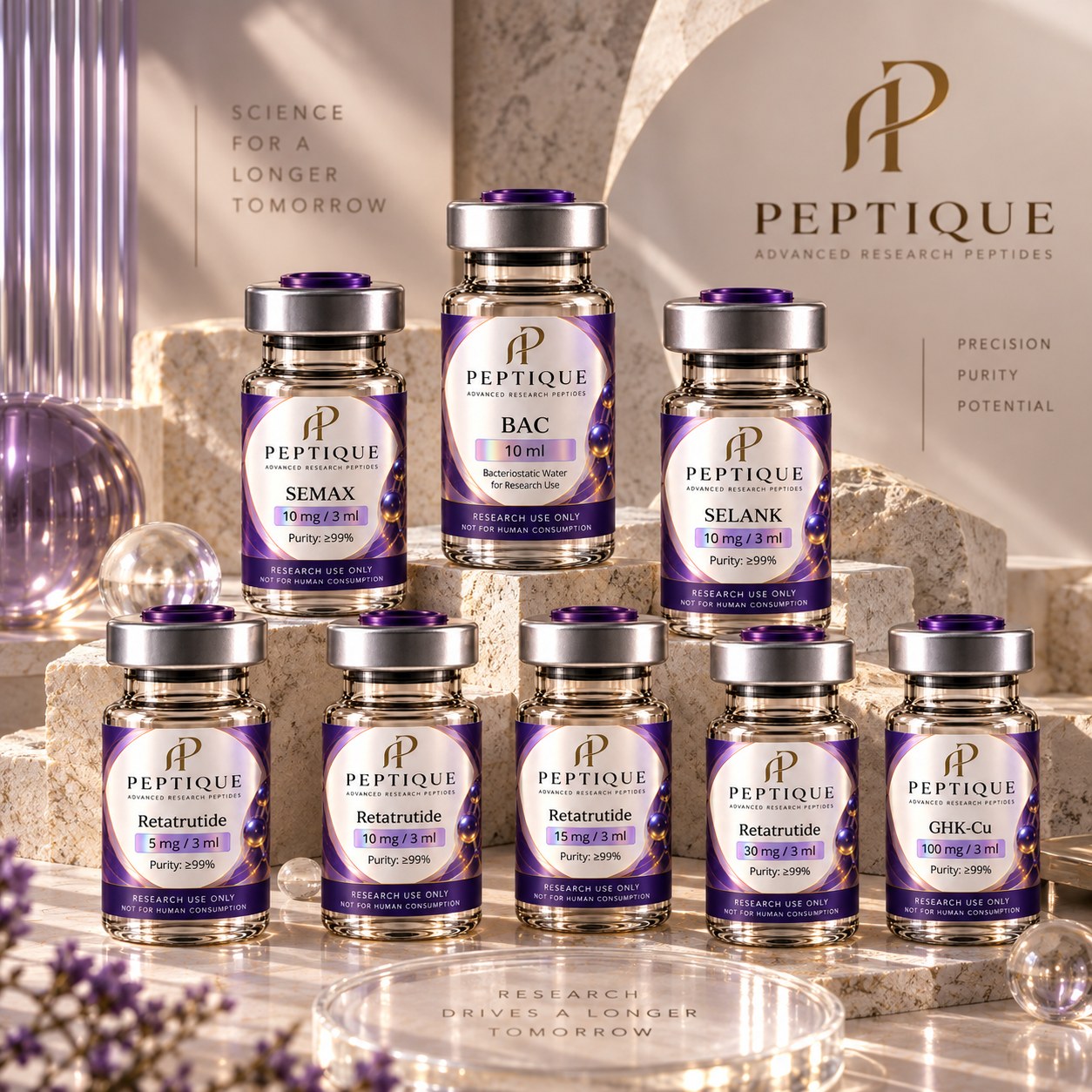
| Status at PEPTIQUE | available, 10 mg / 3 ml | available, 10 mg / 3 ml |
5. Similarities Between the Two Peptides
- They were designed by the same school, using the same strategy: an active natural fragment, stabilized with Pro-Gly-Pro.
- They are small heptapeptides, water-soluble, with identical laboratory handling.
- Both are studied as regulatory peptides — molecules that modulate gene expression and signaling — rather than as ligands for a single, well-defined receptor.
- Both lack the hormonal or immune activity of their parent molecule: Semax does not stimulate the adrenal cortex, Selank does not have tuftsin's phagocytic effect.
6. Advantages and Disadvantages
Semax
- Advantage: the oldest and most extensive literature of the two; genome-wide gene expression data.
- Advantage: documented BDNF/TrkB mechanism, useful as a benchmark in neurotrophin studies.
- Disadvantage: the methionine in the sequence requires attention to oxidation and storage.
Selank
- Advantage: a study model for the neuro-immune interface, a niche with fewer reference molecules.
- Advantage: chemically stable sequence, with no oxidizable amino acids.
- Disadvantage: more limited and more recent literature; many studies come from a single research group.
7. Which One, When: How to Choose Between Them
- Studying neurotrophins, BDNF, hippocampal plasticity? Semax, since it has the reference study on exactly this mechanism.
- Studying the GABAergic system or neuro-immune interaction? Selank.
- Need a regulatory peptide model with transcriptomic data? Semax has the genome-wide analysis.
- Comparing two peptides with the same stabilization strategy but different origins? Use both, as a pair. It is one of the cleanest experimental designs possible: the same Pro-Gly-Pro extension, completely different cores.
8. Reconstitution and Storage
Both peptides are supplied lyophilized, 10 mg in a 3 ml vial, with ≥99% purity. Handling rules:
- The powder is stored at 2–8°C, in its original packaging, protected from light. For Semax, oxidation sensitivity means light and prolonged air exposure matter more.
- Reconstitution is done with bacteriostatic water, added slowly down the wall of the vial, followed by gentle swirling. No shaking, no vortexing.
- The solutions are colorless and clear. Turbidity indicates a problem.
- The reconstituted solution is stored refrigerated, labeled with the date and concentration. Do not repeatedly freeze and thaw.
- For Semax, it is recommended to portion the solution into small volumes, so each portion is opened only once.
9. Conclusion
Selank and Semax are twins only in appearance. They share the same length and the same tail, but one speaks the language of neurotrophins and melanocortins, the other the language of the GABA system and immunity. In a laboratory, that means two different tools for two different questions, or an ideal pair for a comparative design.
PEPTIQUE supplies both heptapeptides, Selank 10 mg and Semax 10 mg, in 3 ml vials, ≥99% purity, with batch traceability and certificate of analysis on request. Research use only.
Frequently asked questions
Are Selank and Semax structurally related?
What role does the Pro-Gly-Pro extension play?
Which of the two is more studied?
How should Selank and Semax be stored?
References
- Ashmarin IP et al. Design and investigation of an ACTH(4-10) analog lacking D-amino acids and hydrophobic radicals. Neurosci Res Commun. 1995;16(2):105-112.
- Dolotov OV et al. Semax, an analog of ACTH(4-10) with cognitive effects, regulates BDNF and trkB expression in the rat hippocampus. Brain Res. 2006;1117(1):54-60.
- Medvedeva EV et al. The peptide semax affects the expression of genes related to the immune and vascular systems in rat brain focal ischemia: genome-wide transcriptional analysis. BMC Genomics. 2014;15:228.
- Kozlovskaya MM et al. Selank and short peptides of the tuftsin family in the regulation of adaptive behavior in stress. Neurosci Behav Physiol. 2003;33(9):853-860.
- Vyunova TV et al. Peptide-based Anxiolytics: The Molecular Aspects of Heptapeptide Selank Biological Activity. Protein Pept Lett. 2018;25(10):924-929.
- Filatova E et al. GABA, Selank, and Olanzapine Affect the Expression of Genes Involved in GABAergic Neurotransmission in IMR-32 Cells. Front Pharmacol. 2017;8:89.
- Kolomin T et al. A new generation of drugs: synthetic peptides based on natural regulatory peptides. Neurosci Med. 2013;4(4):223-252.