Bacteriostatic Water vs. Acetic Acid vs. "Matrix Water": The Complete Peptide Reconstitution Guide
Which reconstitution medium to use for lyophilized peptides, why bacteriostatic water with 0.9% benzyl alcohol is the standard, when acetic acid is needed, what "matrix water" is, and how to reconstitute correctly, step by step.
Reconstitution is the step everyone treats as trivial and many get wrong. A peptide with ≥99% purity can turn, in ten seconds of vigorous shaking or in a medium with the wrong pH, into a solution full of aggregates and fragments. The reconstitution medium is not a detail — it is the first variable of the experiment.
This guide compares the three options found in research peptide catalogs — bacteriostatic water, acetic acid, and so-called "matrix water" — explains what each one is, when to use it, and how to reconstitute correctly, step by step.
1. Why peptides are shipped lyophilized
Peptides are unstable in solution. Peptide bonds hydrolyze slowly, methionine and cysteine oxidize, asparagine and glutamine deamidate, and chains can aggregate. Lyophilization — freezing followed by sublimation of the water under vacuum — removes almost all the water and blocks these reactions (Wang, Int J Pharm, 2000). The resulting powder is stable for months or years at 2–8°C.
The trade-off: the powder must be brought back into solution before use, and from that moment the degradation clock starts again. The medium chosen determines how fast.
2. Bacteriostatic water: the standard
Bacteriostatic water (BAC) is sterile, purified water with 0.9% benzyl alcohol. It is described in a United States Pharmacopeia monograph and is the standard reconstitution medium for lyophilized powders in multi-dose vials.
Benzyl alcohol does not sterilize. It is a bacteriostatic agent: it prevents the growth of bacteria that could enter the vial with each puncture of the stopper. The effectiveness of this concentration is documented in the literature on parenteral preservatives (Meyer et al., J Pharm Sci, 2007) and verified by the antimicrobial effectiveness test in USP general chapter <51>.
What this means for the lab:
- The reconstituted solution can be drawn from multiple times, over several days, without bacterial contamination.
- The pH of bacteriostatic water is mildly acidic to neutral (typically 4.5–7.0), a range compatible with most peptides.
- Benzyl alcohol at 0.9% does not interfere with common peptides. Sensitivities are rare and are documented in the formulation literature.
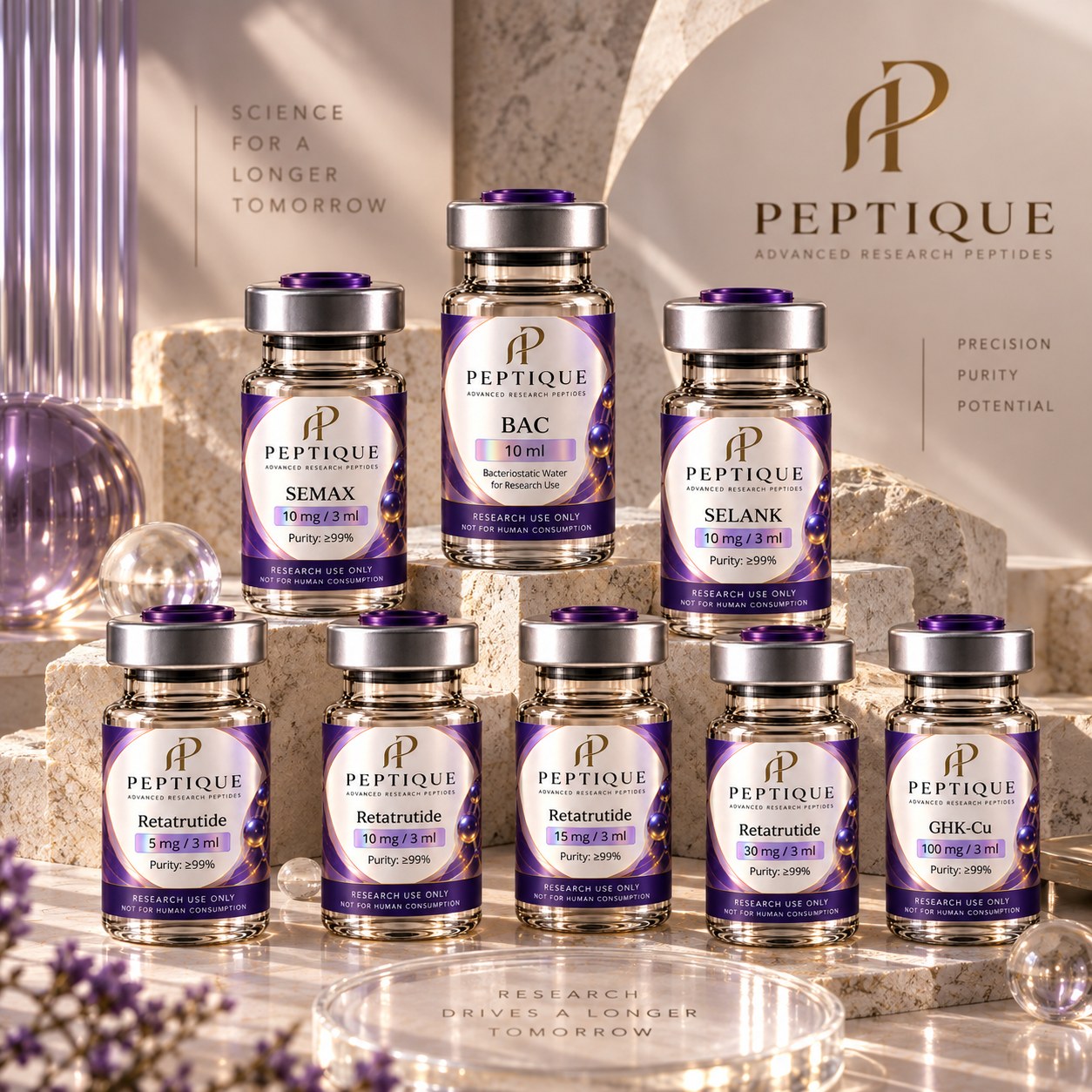
Bacteriostatic water is the right medium for every peptide in the PEPTIQUE catalog: Retatrutide, GHK-Cu, Selank, Semax, and NAD+.
3. Plain sterile water: the single-use alternative
Sterile water for injection, without a preservative, is chemically identical minus the benzyl alcohol. It is used when the entire solution is consumed immediately after reconstitution, in a single draw. After the stopper is first pierced there is no more protection: the vial must be considered contaminable and the solution cannot be stored.
It is the right choice in only two situations: the peptide is sensitive to benzyl alcohol (rare), or the protocol calls for reconstitution with immediate use.
4. Acetic acid: the solution for poorly soluble peptides
Some peptides do not dissolve in water no matter how slowly it is added. These are peptides with many hydrophobic residues (leucine, isoleucine, phenylalanine, valine) or a distinctly basic character. For these, the formulation literature recommends changing the pH: a dilute acetic acid solution (usually 0.1%, sometimes up to 10%) protonates amino groups and breaks up hydrophobic interactions, bringing the peptide into solution (Malavolta et al., Protein Sci, 2006).
Rules:
- Start with the lowest concentration of acetic acid and increase it only if the peptide does not dissolve.
- Acidic peptides (many aspartic or glutamic acid residues) dissolve instead in mildly alkaline buffers, not in acetic acid.
- Acetic acid has no documented bacteriostatic effect at these concentrations. The solution should be used quickly or diluted afterward in bacteriostatic water.
- For NAD+, dilute acetic acid is compatible (NAD+ is stable at acidic pH), but it is not necessary: it dissolves directly in water.
For the peptides in the PEPTIQUE catalog, acetic acid is not necessary. All of them dissolve in bacteriostatic water.
5. "Matrix water" (peptide matrix water): what it is and what it isn't
In recent years, products called "peptide matrix water," "matrix water," or similar have appeared in catalogs, presented as a new generation of reconstitution medium, superior to bacteriostatic water. The descriptions speak of "matrix structures" that supposedly stabilize the peptide.
Three lab-level observations:
- The composition is not fully disclosed. A reconstitution medium needs a known composition so that interference with the experiment can be ruled out. "Matrix" is not a composition.
- No published stability data exist in the peer-reviewed literature comparing these products with bacteriostatic water on defined peptides.
- There is no pharmacopeial monograph. Bacteriostatic water has one. The standard is the standard precisely because it is defined, tested, and reproducible.
The conclusion is not that such products are necessarily harmful, but that they cannot be validated. In a research protocol, a medium with an unknown composition introduces an uncontrolled variable. This is exactly why PEPTIQUE chose to offer bacteriostatic water rather than a proprietary alternative.
6. Comparison table: the three media
| Characteristic | Bacteriostatic water | Dilute acetic acid | "Matrix water" |
|---|---|---|---|
| Composition | sterile water + 0.9% benzyl alcohol | water + 0.1–10% acetic acid | not fully disclosed |
| Pharmacopeial standard | yes (USP) | no, lab-prepared | no |
| Bacteriostatic protection | yes | no | undocumented |
| Repeated draws | yes, multiple days | not recommended | undocumented |
| pH | ~4.5–7.0 | ~3–4 | not disclosed |
| When to use | standard, all water-soluble peptides | insoluble hydrophobic or basic peptides | no validated indication |
| Published stability data | yes | yes, for solubilization | no |
| Status at PEPTIQUE | available, 10 ml | not in the catalog | not in the catalog |
7. Step-by-step reconstitution guide
The procedure below applies to all lyophilized peptides in the PEPTIQUE catalog.
- Temperature. The powder vial is taken out of the refrigerator and left closed for 15–20 minutes at room temperature. Opened cold, it condenses water inside.
- The calculation. Determine the desired final concentration and calculate the volume of bacteriostatic water needed. Example: 10 mg of peptide in 2 ml of water gives 5 mg/ml. Write down the calculation before starting.
- Drawing the water. Disinfect the stopper of the bacteriostatic water vial and draw the calculated volume with a sterile syringe.
- Adding the water. Insert the needle into the tilted powder vial and let the water run slowly down the glass wall, not directly onto the powder. A direct stream breaks up the lyophilized cake and promotes foaming.
- Dissolving. Gently roll the vial between your fingers or tilt it slowly. Do not shake. Do not use a vortex. Peptides with a fatty acid chain, such as Retatrutide, are especially sensitive to mechanical shear.
- Checking. The solution should be clear, with no particles. GHK-Cu gives a blue-violet solution, the others are colorless. Persistent turbidity means aggregation or an unsuitable pH.
- Labeling. Write the peptide, concentration, reconstitution date, and operator's initials on the vial.
- Storage. The solution goes straight into the refrigerator, at 2–8°C, protected from light. Do not freeze and thaw repeatedly; if the protocol requires freezing, aliquot it first.
8. Common mistakes and what they cause
- Vigorous shaking: aggregation, foam, loss of activity. The most common mistake.
- Cold water added to warm powder, or the reverse: uneven dissolution, condensation.
- Alkaline buffer for NAD+: rapid degradation into nicotinamide and ADP-ribose.
- Plain sterile water with repeated draws: bacterial contamination within days.
- Repeated freeze-thaw cycles: aggregation and accelerated hydrolysis.
- No label: solutions of unknown age, results impossible to interpret.
9. Conclusion
Bacteriostatic water is the reconstitution standard for a simple reason: it has a known composition, documented protection, and decades of use. Acetic acid is the specialized tool for peptides that refuse to dissolve in water. "Matrix water" remains, until its composition and stability data are published, an uncontrolled variable.
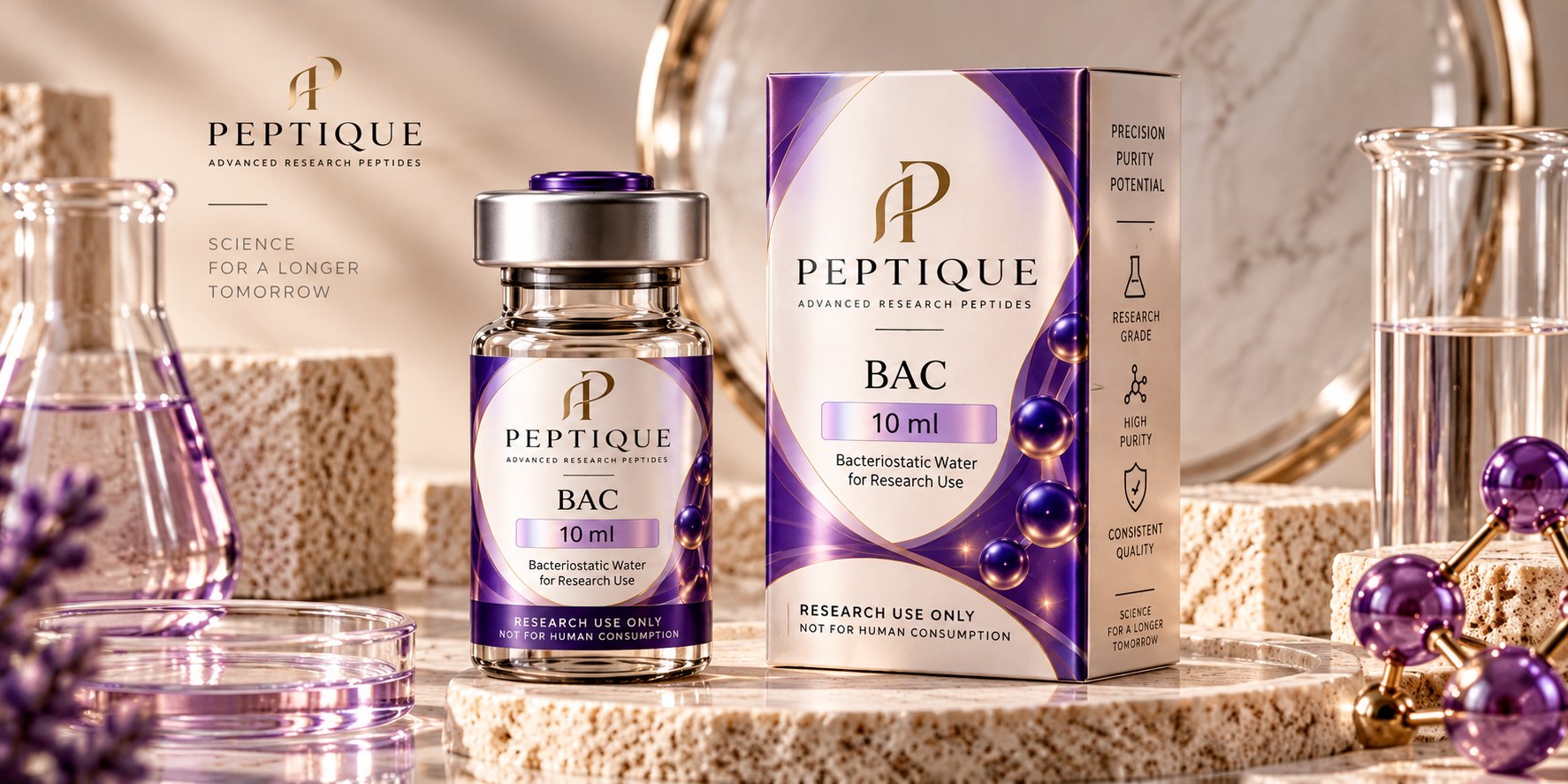
PEPTIQUE supplies bacteriostatic water, 10 ml, 0.9% benzyl alcohol, for reconstituting the peptides in the catalog. Research use only.
Frequently asked questions
What is bacteriostatic water?
Can I use plain sterile water instead of bacteriostatic water?
When is acetic acid needed?
What is "matrix water" or "peptide matrix water"?
References
- Meyer BK, Ni A, Hu B, Shi L. Antimicrobial preservative use in parenteral products: past and present. J Pharm Sci. 2007;96(12):3155-3167.
- Wang W. Lyophilization and development of solid protein pharmaceuticals. Int J Pharm. 2000;203(1-2):1-60.
- Manning MC, Chou DK, Murphy BM, Payne RW, Katayama DS. Stability of protein pharmaceuticals: an update. Pharm Res. 2010;27(4):544-575.
- Malavolta L, Pinto MR, Cuvero JH, Nakaie CR. Interpretation of the dissolution of insoluble peptide sequences based on the acid-base properties of the solvent. Protein Sci. 2006;15(6):1476-1488.
- Powell MF, Nguyen T, Baloian L. Compendium of excipients for parenteral formulations. PDA J Pharm Sci Technol. 1998;52(5):238-311.
- United States Pharmacopeia. Bacteriostatic Water for Injection, monograph; General Chapter <51> Antimicrobial Effectiveness Testing.