NAD+ 1000 mg: research guide, mechanisms and comparison with NMN and NR
What NAD+ is, why it declines with age, which enzymes consume it (sirtuins, PARP, CD38), how it compares with the precursors NMN and NR, and how it is reconstituted and stored in the laboratory.
NAD+ is, arguably, the most-cited molecule in longevity research over the past decade. It is also one of the most misunderstood. It gets talked about as a "supplement", gets confused with its precursors, and almost everything that actually matters in a laboratory gets ignored: the chemistry, the stability, and how it is handled.
This guide explains what NAD+ is, which enzymes consume it, why it declines with age, how it compares with NMN and NR, and how to work correctly with the 1000 mg lyophilised form.
1. What NAD+ is
Nicotinamide adenine dinucleotide is a coenzyme made of two nucleotides linked through phosphate groups: one contains adenine, the other nicotinamide. It exists in two interconverting forms: NAD+ (oxidised) and NADH (reduced). The NAD+/NADH ratio is one of the basic indicators of a cell's redox state.
NAD+'s classic role is as an electron carrier: it accepts a hydride ion in glycolysis, the Krebs cycle and fatty-acid beta-oxidation, then delivers electrons to the mitochondrial respiratory chain. Without NAD+, there is no ATP production.
The modern role — the one that has placed the molecule at the centre of longevity research — is as a consumed substrate. Three enzyme families cleave NAD+ to function:
- Sirtuins (SIRT1–SIRT7): NAD+-dependent deacetylases that regulate gene expression, DNA repair and mitochondrial metabolism (Imai and Guarente, Trends Cell Biol, 2014).
- PARPs: DNA-repair enzymes that consume large amounts of NAD+ when activated by damage (Bai and Cantó, Cell Metab, 2012).
- CD38: a NADase whose activity increases with age and which has been identified as the main driver of the age-related NAD+ decline, in murine models (Camacho-Pereira et al., Cell Metab, 2016).
2. Why NAD+ declines with age
The review by Covarrubias et al. (Nature Reviews Molecular Cell Biology, 2021) describes a progressive imbalance: consumption rises, synthesis falls. On one side, CD38 and PARPs activated by accumulated damage cleave increasing amounts of NAD+. On the other, NAMPT, the rate-limiting enzyme of the salvage pathway, decreases in expression across several tissues.
The documented result, in animal models and human samples: reduced NAD+ levels in liver, muscle, skin and brain with advancing age. This decline is considered one of the hallmarks of ageing at the molecular level and explains why restoring NAD+ is one of the most active directions in current research.
3. Synthesis pathways: where NAD+ in the cell comes from
The cell produces NAD+ through three pathways:
- The de novo pathway, from tryptophan, through eight enzymatic reactions. It is slow and active mainly in the liver.
- The Preiss-Handler pathway, from nicotinic acid (niacin), via NAPRT.
- The salvage pathway, from nicotinamide, via NAMPT and then NMNAT. This is the dominant pathway in most tissues, and it recycles the nicotinamide released by sirtuins, PARPs and CD38.
The precursors NMN and NR enter the salvage pathway: NR is phosphorylated to NMN by the NRK1/2 kinases, and NMN is converted to NAD+ by NMNAT. This is where the key difference lies between working with NAD+ directly and working with precursors.
4. NAD+ vs. NMN vs. NR: comparison table
| Feature | NAD+ | NMN | NR |
|---|---|---|---|
| What it is | end-point coenzyme | precursor (mononucleotide) | precursor (riboside) |
| Molecular mass | ~663 Da | ~334 Da | ~255 Da (free base) |
| Conversion pathway | none needed | NMNAT → NAD+ | NRK → NMN → NAD+ |
| Crosses the cell membrane | limited; requires transporters or extracellular breakdown | limited; Slc12a8 transporter reported, debated | yes, relatively easily |
| Typical laboratory use | in vitro enzymatic studies, redox assays, sirtuins/PARP, cell culture | salvage-pathway studies, animal models | bioavailability studies, animal models (Trammell et al., 2016) |
| Stability in solution | sensitive to alkaline pH and heat | moderate | moderate, hygroscopic |
| Key review reference | Covarrubias 2021 | Yoshino 2018 | Yoshino 2018; Trammell 2016 |
| Status at PEPTIQUE | available, 1000 mg / 10 ml | not in catalogue | not in catalogue |
5. When to use NAD+ directly and when to use precursors
The choice depends on the question:
- Studying the activity of a NAD+-dependent enzyme in vitro (sirtuin, PARP, dehydrogenase)? Direct NAD+, as substrate. Precursors are of no use here, since there is no cell to convert them.
- Studying the NAD+/NADH ratio or redox state in cell lysates? Direct NAD+, as a calibration standard for assays.
- Studying biosynthesis and the salvage pathway in cells or animal models? Precursors, since their conversion is precisely the object of the study.
- Comparing the effect of direct supplementation against precursors in cell culture? All three are needed, with NAD+ as the reference.
For this reason, high-purity NAD+ is the base reagent of any laboratory working in this field, whether or not precursors appear in the protocol.
6. What the published studies show
The review by Rajman, Chwalek and Sinclair (Cell Metabolism, 2018) surveys the in vivo evidence for NAD+-boosting molecules, in animal models: effects on mitochondrial function, insulin sensitivity, muscle function and several markers of ageing. The study by Trammell et al. (Nature Communications, 2016) documented NR pharmacokinetics in mice and in humans, showing that NR raised blood NAD+ in a dose-dependent manner.
These data are cited for scientific context. PEPTIQUE supplies NAD+ as a research reagent, and published results do not carry over to the product.
7. The chemistry of stability: what the lab needs to know
NAD+ has a structural weak point: the glycosidic bond between nicotinamide and ribose. This bond breaks easily under three conditions:
- Alkaline pH. Above pH 7.5, NAD+ degrades rapidly, releasing nicotinamide and ADP-ribose. At pH 8–9, the half-life in solution is measured in hours at room temperature.
- Heat. Degradation accelerates sharply above 25°C. Solutions should not be left on the bench.
- Light. Prolonged UV exposure promotes degradation.
Conversely, NAD+ is stable at slightly acidic pH (5–6) and in the cold. The reduced form, NADH, behaves oppositely: stable at alkaline pH, unstable at acidic pH. A laboratory working with both forms needs to use different buffers.
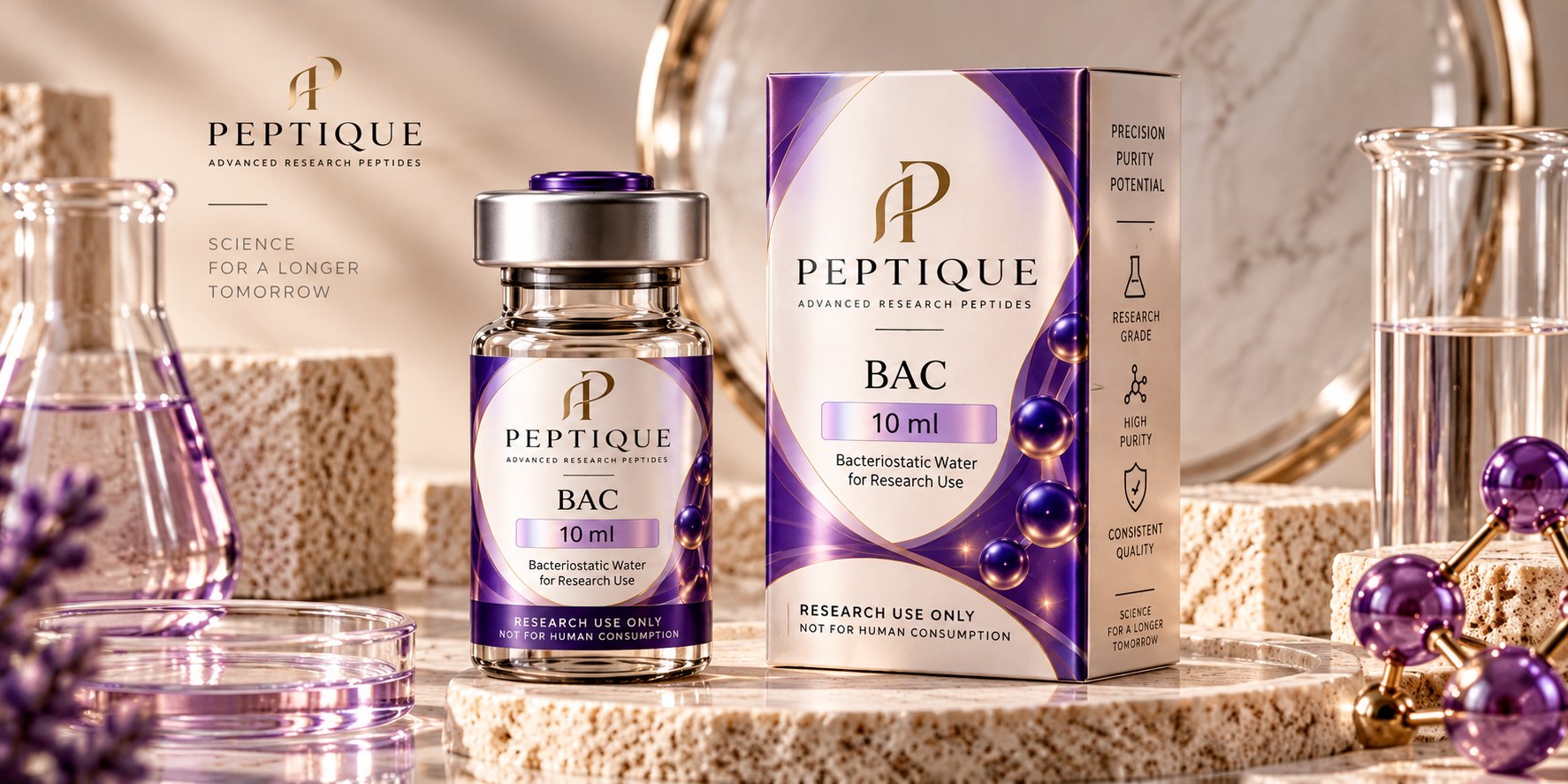
Practical consequence: PEPTIQUE's lyophilised NAD+ is reconstituted in bacteriostatic water (slightly acidic pH, suitable) or in a buffer chosen per protocol — never in alkaline buffers such as Tris at pH 8 or bicarbonate.
8. Reconstitution and storage
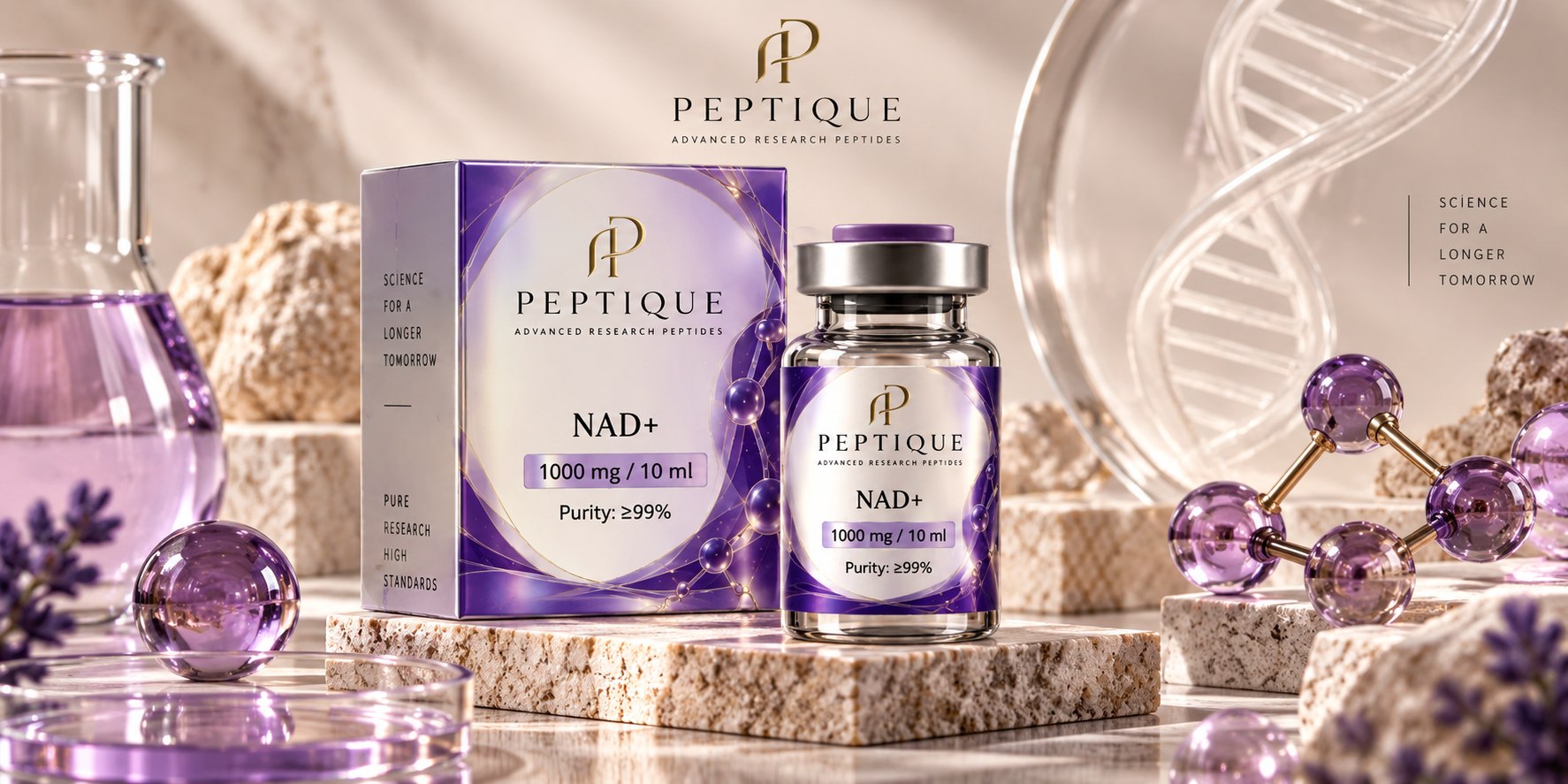
NAD+ is supplied lyophilised, 1000 mg in a 10 ml vial, ≥99% purity. The rules:
- The powder is stored at 2–8°C, protected from light and humidity. NAD+ is hygroscopic: the vial should only be opened at room temperature, to avoid water condensing inside.
- Reconstitution is done with bacteriostatic water or with the buffer set by the protocol, added slowly. NAD+ dissolves easily; the solution is clear and colourless.
- The solution's pH is checked if the protocol requires it. Below 7 is the safe zone.
- The solution is portioned into small volumes and stored refrigerated. For longer storage, portions are frozen once only; they should not be thawed and refrozen repeatedly.
- The reconstitution date and concentration are noted on the vial. An old solution, kept warm or at the wrong pH, already contains nicotinamide and ADP-ribose instead of NAD+.
9. Conclusion
NAD+ is not a "supplement" — it is the central coenzyme of energy metabolism and the substrate of the three enzyme families at the heart of longevity research. NMN and NR are routes to NAD+; NAD+ is the destination and, in the lab, the reference reagent. The difference between a usable result and an unusable one often comes down to the pH of the solution and the temperature at which the vial was kept.
PEPTIQUE supplies NAD+ 1000 mg, 10 ml vial, ≥99% purity, with batch traceability and a certificate of analysis on request. Research use only.
Frequently asked questions
What is NAD+ and why does it matter in research?
What is the difference between NAD+, NMN and NR?
How is NAD+ stored, lyophilised and in solution?
Is PEPTIQUE's NAD+ intended for human use?
References
- Covarrubias AJ, Perrone R, Grozio A, Verdin E. NAD+ metabolism and its roles in cellular processes during ageing. Nat Rev Mol Cell Biol. 2021;22(2):119-141.
- Yoshino J, Baur JA, Imai SI. NAD+ Intermediates: The Biology and Therapeutic Potential of NMN and NR. Cell Metab. 2018;27(3):513-528.
- Rajman L, Chwalek K, Sinclair DA. Therapeutic Potential of NAD-Boosting Molecules: The In Vivo Evidence. Cell Metab. 2018;27(3):529-547.
- Imai S, Guarente L. NAD+ and sirtuins in aging and disease. Trends Cell Biol. 2014;24(8):464-471.
- Camacho-Pereira J et al. CD38 Dictates Age-Related NAD Decline and Mitochondrial Dysfunction through an SIRT3-Dependent Mechanism. Cell Metab. 2016;23(6):1127-1139.
- Bai P, Cantó C. The role of PARP-1 and PARP-2 enzymes in metabolic regulation and disease. Cell Metab. 2012;16(3):290-295.
- Trammell SA et al. Nicotinamide riboside is uniquely and orally bioavailable in mice and humans. Nat Commun. 2016;7:12948.