GHK-Cu vs AHK-Cu: What Is the Difference Between the Two Copper Tripeptides
Technical comparison between GHK-Cu (glycyl-histidyl-lysine) and AHK-Cu (alanyl-histidyl-lysine) — structure, copper binding, published data, research applications, reconstitution, and stability.
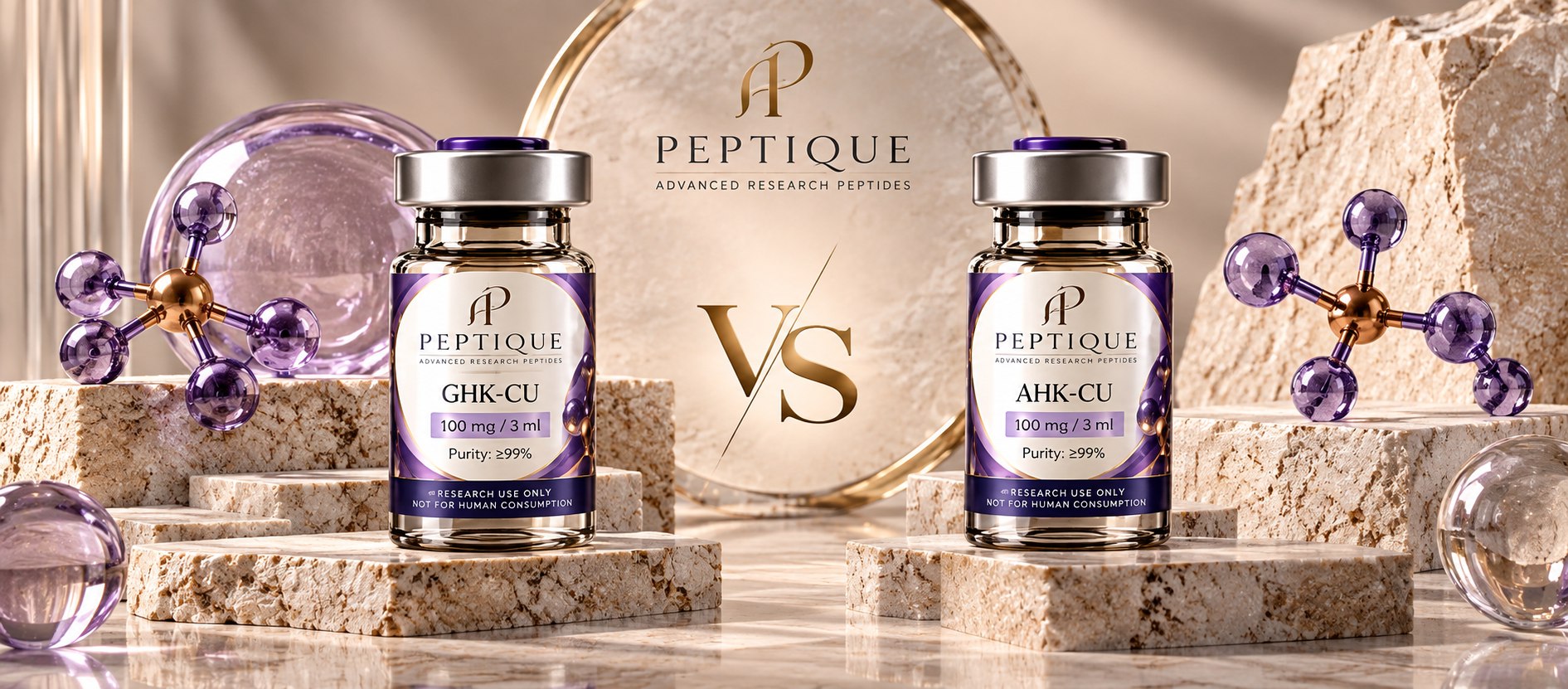
Copper peptides are among the oldest molecules in dermatological and tissue research, and yet the confusion between GHK-Cu and AHK-Cu persists. Both are sold under the same generic name, "copper peptide," share the same blue-violet color in solution, and differ by a single amino acid. That one-amino-acid difference, however, separates a molecule with more than fifty years of literature from one with only a handful of studies.
This article explains the structure of each, how they bind copper, what has been published on each, and how to choose between them in a research protocol.
1. What Is GHK-Cu (Glycyl-L-Histidyl-L-Lysine)
GHK is a naturally occurring tripeptide made up of glycine, histidine, and lysine. It was identified in human plasma by Loren Pickart in 1973, in a study observing that serum from younger individuals contained a factor capable of prolonging the survival of liver cells in culture (Pickart and Thaler, Nature New Biology, 1973). That factor turned out to be GHK, and its activity depended on binding the copper(II) ion.
Plasma GHK concentration declines with age: approximately 200 ng/ml at age 20, approximately 80 ng/ml at age 60, according to data cited in review literature. This decline became the starting point for most research programs on the peptide's role in tissue remodeling.
The GHK-Cu complex results from binding a copper(II) ion to the tripeptide. Histidine at position 2 and the terminal amino group of glycine form the main coordination site, with an affinity constant on the order of 10^16, comparable to that of albumin. In practice, GHK can take up copper from albumin and deliver it to cells.
2. What Is AHK-Cu (L-Alanyl-L-Histidyl-L-Lysine)
AHK is a synthetic tripeptide in which the glycine at position 1 has been replaced with alanine. The rest of the sequence (His-Lys) is identical, as is the mechanism of copper binding through histidine and the terminal amino group.
Unlike GHK, AHK has no history of isolation from plasma and is not described as an endogenous peptide. It appeared in the literature in the 2000s, in hair follicle studies: Pyo et al. (Archives of Pharmacal Research, 2007) reported the effect of the AHK-Cu complex on dermal papilla cell proliferation in culture. This remains the molecule's principal reference.
The structural difference — one additional methyl group on the first amino acid — slightly alters the geometry of the coordination site and the peptide's hydrophobicity. The consequences have been documented far less than in the case of GHK.
3. Mechanism: How Copper Peptides Work in Research
Both tripeptides are studied as copper carriers and as extracellular matrix remodeling signals. Three research directions dominate the literature:
- Collagen and glycosaminoglycan synthesis. Maquart et al. (FEBS Letters, 1988) showed that GHK-Cu stimulates collagen synthesis in fibroblast cultures at nanomolar concentrations. This study established GHK-Cu as the reference peptide in matrix research.
- Controlled copper delivery. Copper is a cofactor for lysyl oxidase (collagen and elastin cross-linking), superoxide dismutase, and cytochrome c oxidase. The free ion is toxic; the peptide delivers it in a coordinated form, which allows the enzymatic role of copper to be studied without the effects of the free ion.
- Gene expression modulation. Connectivity Map analysis (the database described by Lamb et al., Science, 2006) showed that GHK alters the expression of more than 4,000 human genes, with effects on DNA repair, antioxidant, and tissue remodeling pathways (Pickart and Margolina, Int J Mol Sci, 2018). No equivalent analysis exists for AHK.
4. Table: GHK-Cu vs AHK-Cu, Full Comparison
| Feature | GHK-Cu | AHK-Cu |
|---|---|---|
| Sequence | Gly-His-Lys | Ala-His-Lys |
| Origin | endogenous, isolated from human plasma (1973) | synthetic, no documented plasma counterpart |
| Molecular mass (free peptide) | ~340 Da | ~354 Da |
| Copper binding | His-2 + terminal amino group; affinity ~10^16 | same site; reported affinity similar, less characterized |
| Volume of literature | hundreds of studies, 5 decades | a handful of studies, concentrated after 2007 |
| Main research areas | extracellular matrix, collagen, tissue repair, gene expression | hair follicle, dermal papilla cells |
| Gene expression data | yes (Connectivity Map, >4,000 genes) | no |
| Color in solution | blue-violet | blue-violet |
| Status at PEPTIQUE | available, 100 mg / 3 ml, research use only | not in catalog |
5. Similarities Between the Two Peptides
It would be a mistake to treat them as unrelated molecules. Both:
- bind copper(II) through the same coordination mechanism, dominated by histidine;
- are small, hydrophilic, water-soluble tripeptides with identical lab handling;
- are used in research at nanomolar to micromolar concentrations;
- form colored complexes, which allows visual verification of reconstitution;
- are stable as lyophilized powder at 2–8°C, but sensitive to light and to extreme pH in solution.
From a lab's perspective, the difference is not in handling but in what can be concluded from the result. With GHK-Cu, the result can be referenced against a vast body of literature. With AHK-Cu, almost any observation is new, and therefore also harder to validate.
6. Advantages and Disadvantages
GHK-Cu
- Advantage: extensive literature, documented mechanisms, gene expression data, endogenous molecule with reference plasma values.
- Advantage: the standard peptide in extracellular matrix studies, offering comparability with published results.
- Disadvantage: precisely because it is so well studied, entirely new questions are scarcer.
AHK-Cu
- Advantage: a lightly explored research niche, particularly the hair follicle.
- Disadvantage: limited data, no gene expression profile, no endogenous reference values.
- Disadvantage: results are hard to compare against the literature, because the literature barely exists.
7. Which One When: How to Choose the Right Peptide
- Studying collagen synthesis, matrix remodeling, tissue repair, or gene expression? GHK-Cu. It is the reference peptide and the only one with Connectivity Map data.
- Studying the role of copper as an enzymatic cofactor? GHK-Cu, because its affinity and transfer kinetics are characterized.
- Studying dermal papilla cells and the hair follicle specifically? AHK-Cu has a few direct references, but GHK-Cu also has data in the same direction plus a much broader context.
- Need a validated positive control? GHK-Cu, without question.
PEPTIQUE chose to offer GHK-Cu, not AHK-Cu, for exactly this reason: it is the molecule a lab can reference against the literature.
8. Reconstitution and Storage
GHK-Cu is supplied as a lyophilized powder, 100 mg in a 3 ml vial, with ≥99% purity. Handling guidelines:
- Store the powder at 2–8°C, in its original packaging, protected from direct light. The copper complex is photosensitive.
- Reconstitute with bacteriostatic water, added slowly along the vial wall. Swirl gently until dissolved. Do not shake or vortex.
- The solution has a uniform blue-violet color. A colorless or cloudy solution indicates a reconstitution or degradation issue.
- The working pH recommended in the literature is close to neutral. At acidic pH, copper dissociates from the peptide and the solution loses its color.
- The reconstituted solution is kept refrigerated, labeled with date and concentration, and used within the timeframe set by the lab's protocol.
9. Conclusion
GHK-Cu and AHK-Cu differ by a single amino acid and by half a century of literature. For nearly any research question involving copper, the extracellular matrix, or tissue remodeling, GHK-Cu is the molecule against which results can be compared, validated, and published.
PEPTIQUE supplies GHK-Cu 100 mg, 3 ml vial, ≥99% purity, with batch traceability and certificate of analysis on request. Research use only.
Frequently asked questions
Are GHK-Cu and AHK-Cu the same molecule?
Which of the two has more published data?
Why is copper bound to the peptide instead of added separately?
How is GHK-Cu reconstituted and stored?
References
- Pickart L, Thaler MM. Tripeptide in human serum which prolongs survival of normal liver cells and stimulates growth in neoplastic liver. Nat New Biol. 1973;243(124):85-87.
- Maquart FX et al. Stimulation of collagen synthesis in fibroblast cultures by the tripeptide-copper complex glycyl-L-histidyl-L-lysine-Cu2+. FEBS Lett. 1988;238(2):343-346.
- Pickart L. The human tri-peptide GHK and tissue remodeling. J Biomater Sci Polym Ed. 2008;19(8):969-988.
- Pickart L, Margolina A. Regenerative and Protective Actions of the GHK-Cu Peptide in the Light of the New Gene Data. Int J Mol Sci. 2018;19(7):1987.
- Pickart L, Vasquez-Soltero JM, Margolina A. GHK Peptide as a Natural Modulator of Multiple Cellular Pathways in Skin Regeneration. Biomed Res Int. 2015;2015:648108.
- Pyo HK et al. The effect of tripeptide-copper complex on human hair growth in vitro. Arch Pharm Res. 2007;30(7):834-839.
- Lamb J et al. The Connectivity Map: using gene-expression signatures to connect small molecules, genes, and disease. Science. 2006;313(5795):1929-1935.