How to Read a Certificate of Analysis: HPLC, Mass Spectrometry, and What ≥99% Purity Means
Guide to interpreting a research peptide's Certificate of Analysis (COA): HPLC chromatography, mass spectrometry, peptide content, water, counterions, endotoxins, batch number, and what a certificate does not say.
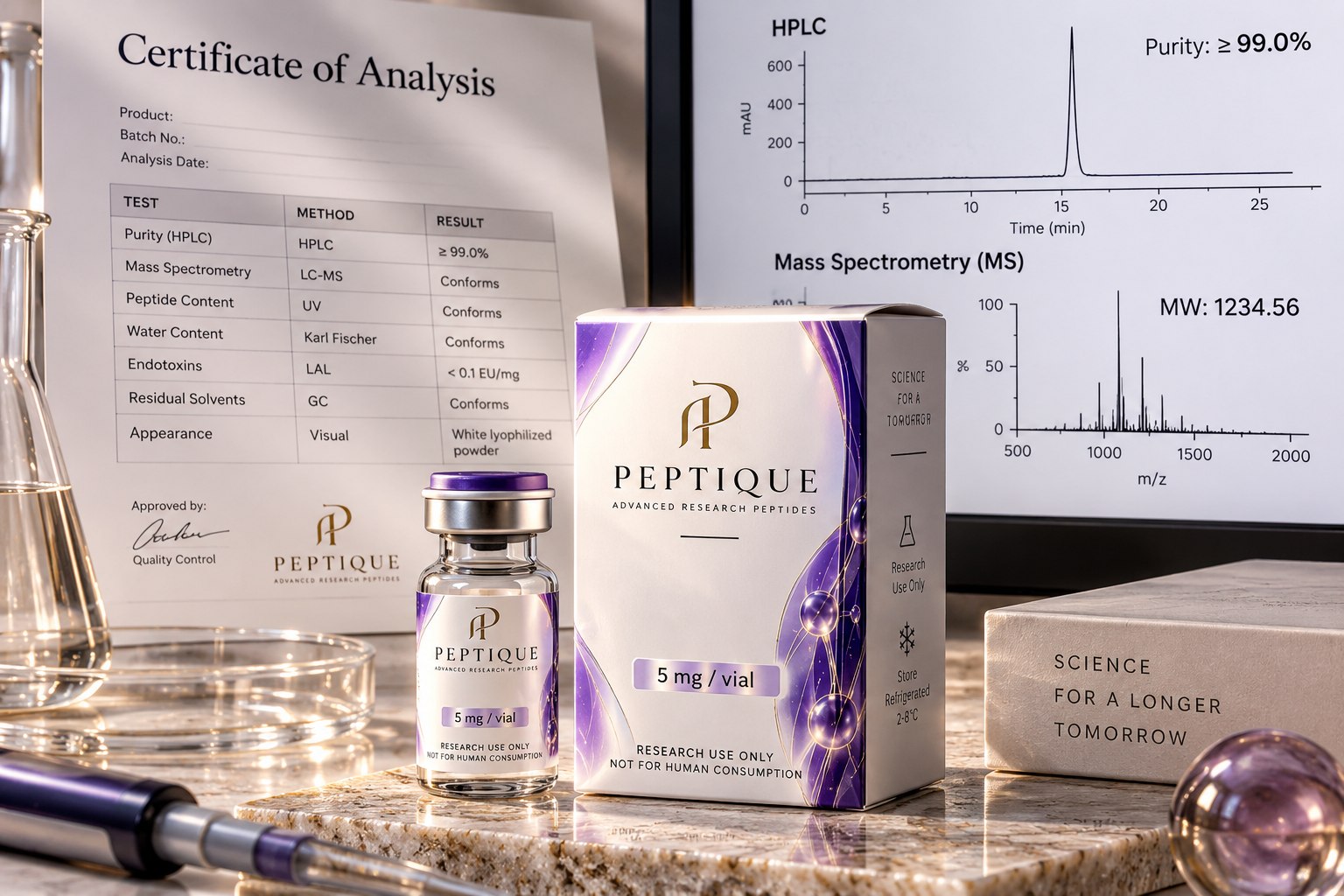
"≥99% purity" appears on every PEPTIQUE vial. It is a precise, verifiable claim, backed by a method. It is also one of the most misunderstood figures in peptide catalogs, where it sometimes serves as a marketing claim with no document behind it.
The document behind it is called the Certificate of Analysis. This guide explains what it contains, which methods sit behind each line, how to read a chromatogram and a mass spectrum, and what a certificate cannot say, however good it is.
1. What a Certificate of Analysis is, and why it is tied to a batch
The Certificate of Analysis (COA) is the report of tests performed on a specific product batch. A batch is the quantity produced in a single synthesis or a single purification and lyophilization cycle, with homogeneous properties. Two batches of the same peptide can give slightly different results, which is why the certificate always carries the batch number, manufacturing date, and expiry date.
On the PEPTIQUE box and vial, these three pieces of information are printed next to the QR code. The certificate should be requested for the batch number on the vial in hand, not for "Retatrutide" in general. A certificate with no batch number, or with a batch that doesn't match the vial, says nothing about your product.
The reference framework for peptide quality specifications is described by Vergote et al. (Journal of Peptide Science, 2009), and the classification of related impurities by D'Hondt et al. (Journal of Pharmaceutical and Biomedical Analysis, 2014).
2. Identity: mass spectrometry
The first question a certificate answers is: is the molecule in the vial the one on the label? The answer comes from mass spectrometry.
The standard method for peptides is electrospray ionization (ESI-MS), the technique described by Fenn et al. in Science in 1989 and later awarded the Nobel Prize. The peptide is ionized from solution, and the instrument measures the mass-to-charge ratio of the ions. From this, the measured molecular weight is calculated.
What is compared:
- Theoretical mass, calculated from the amino acid sequence. For retatrutide, approximately 4,731 Da. For GHK (without copper), 340.4 Da. For Selank, 751.9 Da. For Semax, 813.9 Da.
- Measured mass, reported on the certificate.
The acceptable difference is on the order of 0.1% or less for modern instruments. A measured mass differing by 16 Da indicates oxidation (an extra oxygen atom, typically on methionine). A difference of 1 Da can indicate deamidation. A completely different mass means a different molecule.
On the certificate, the line is usually labeled "Identity (MS)" or "Molecular weight (ESI-MS)", with the theoretical and measured values side by side.
3. Purity: HPLC chromatography
The second question: what proportion of the vial's contents is the correct molecule? The answer comes from high-performance liquid chromatography (HPLC), in its reversed-phase variant (RP-HPLC), the reference method for peptides (Mant and Hodges, 1991; USP <621>).
The principle: the peptide solution is pumped through a column packed with hydrophobic particles. Molecules separate according to hydrophobicity, each exiting the column at its own "retention time." A UV detector, usually at 214 nm or 220 nm, where the peptide bond absorbs, records a peak for each molecular species.
The result is the chromatogram: a graph with time on the horizontal axis and signal on the vertical axis. Purity is calculated as a percentage of the total area:
Purity (%) = main peak area / sum of all peak areas × 100
"≥99% purity" means the correct peptide's peak accounts for at least 99% of the sum of areas. The remainder, under 1%, consists of related impurities: sequences missing an amino acid (deletions), sequences with an incompletely deprotected amino acid, oxidized forms, deamidated forms, dimers.
Worth checking on the chromatogram, if the certificate includes it:
- A single dominant, sharp peak. Double peaks or shoulders on the main peak indicate isomers or closely related forms.
- A clean baseline. High noise or baseline drift reduce confidence in the integration.
- Stated method conditions: column, gradient, wavelength. Without them, the percentage is not reproducible.
4. Purity vs. peptide content: the difference many overlook
This is where the most common confusion lies. HPLC purity answers the question "what proportion of the peptide is correct." It does not answer the question "what proportion of the powder is peptide."
The lyophilized powder contains, besides the peptide:
- Water, bound to the powder, typically 3–8% of mass. Measured by Karl Fischer titration.
- Counterions, the peptide's salt, usually acetate or trifluoroacetate (TFA), left over from purification. Can account for 5–15% of mass, depending on the number of basic residues in the sequence.
The sum of these components gives the "net peptide content," determined by amino acid analysis (Rutherfurd and Gilani, 2009) or by elemental nitrogen analysis. Typical values: 75–90%.
The practical consequence: a vial labeled "10 mg" with 99% purity and 80% net peptide content contains 8 mg of active peptide. For calculating concentration after reconstitution, net content matters, not purity alone. A complete certificate reports both values.
5. Other lines on a complete certificate
- Appearance. White or off-white, lyophilized powder. For GHK-Cu, a blue-violet powder. Any other color is a warning sign.
- Solubility. Clear in water at the stated concentration.
- TFA content. Relevant when the peptide comes as a TFA salt; residual TFA can interfere with some cell-based assays.
- Bacterial endotoxins. Measured by the LAL test (USP <85>), expressed in EU/mg. Relevant for sensitive cell cultures and animal models.
- Bioburden / sterility. The number of viable microorganisms, where applicable.
- Methods and instruments. A serious certificate names the method for each result.
6. What a certificate does not say
A Certificate of Analysis, however complete, has limits:
- It says nothing about stability after opening. The results describe the batch at the time of testing. What happens after reconstitution depends on the laboratory.
- It does not guarantee biological activity. Chemical purity and mass identity do not measure whether the peptide binds its receptor. Activity is tested in the experimental model.
- It does not replace the cold chain. A perfect batch at dispatch, shipped at elevated temperature, arrives as a different batch.
- It cannot be generic. A certificate with no batch number, or a "representative" one covering the whole product line, has no analytical value.
7. How PEPTIQUE handles this
Every PEPTIQUE batch leaves with the batch number, manufacturing date, and expiry date printed on the vial and box. The batch's Certificate of Analysis is available on request, via WhatsApp, for any customer who provides the batch number. The purity stated on the label, ≥99%, is that batch's HPLC purity.
8. Conclusion
A Certificate of Analysis is not a stamp of approval — it is a set of measurements backed by methods: mass spectrometry for identity, HPLC for purity, Karl Fischer and amino acid analysis for net content. Anyone who knows how to read these lines can tell a real "99%" from a decorative one. Anyone who requests the certificate for the batch in hand is working with data, not promises.
PEPTIQUE supplies research peptides with ≥99% HPLC purity, batch traceability, and a Certificate of Analysis on request. Research use only.
Frequently asked questions
What is a Certificate of Analysis (COA)?
What does ≥99% purity by HPLC mean?
What is the difference between purity and peptide content?
How do I get the Certificate of Analysis for a PEPTIQUE product?
References
- Vergote V, Burvenich C, Van de Wiele C, De Spiegeleer B. Quality specifications for peptide drugs: a regulatory-pharmaceutical approach. J Pept Sci. 2009;15(11):697-710.
- D'Hondt M et al. Related impurities in peptide medicines. J Pharm Biomed Anal. 2014;101:2-30.
- Mant CT, Hodges RS (eds). High-Performance Liquid Chromatography of Peptides and Proteins: Separation, Analysis, and Conformation. CRC Press; 1991.
- Fenn JB, Mann M, Meng CK, Wong SF, Whitehouse CM. Electrospray ionization for mass spectrometry of large biomolecules. Science. 1989;246(4926):64-71.
- Rutherfurd SM, Gilani GS. Amino acid analysis. Curr Protoc Protein Sci. 2009;Chapter 11:Unit 11.9.
- United States Pharmacopeia. General Chapter <85> Bacterial Endotoxins Test; General Chapter <621> Chromatography.